Happy Boulders
V3 – V6 · 4 routes · basalt · V-scale
- Approach 10 min — sandy wash from the signed car park, then a maze of volcanic boulders
- Best season October to April. November and March are the best combination of cool rock and mild air.
- Published
- Updated
The Happy Boulders are the friendliest and most populated bouldering area in Bishop: orange volcanic tuff, short approaches, and a huge number of problems in the V0 to V6 range. It is also the warmest area in winter, which matters in a valley that drops below freezing at night.
The rock
Bishop tuff is a welded volcanic rock: coarse, orange, and full of the small sharp pockets and edges that give the area its characteristic style. Holds are generally positive but the rock is abrasive — a four-hour session will cost you skin.
The problems are mostly steep and athletic rather than technical. Expect roof climbing, big moves between good holds, and top-outs that need a proper look the first time.
Season and temperature
Bishop sits at 1,300 m. The season is October to April; mid-winter days are cold in the shade and pleasant in the sun, and the boulder field is warm enough to climb in a T-shirt by 11:00 on a clear January day.
Summer is genuinely dangerous — 35 °C and no shade. Anyone visiting between June and September should be bouldering at altitude instead.
Logistics and access
There is a day-use fee and a self-registration envelope system at the car park; the area is managed by the BLM and the fee pays for the toilets and trails. Camping along the Buttermilk road is dispersed and free but has no facilities, and it is heavily used in season.
The nearest town is Bishop, fifteen minutes away, with gear shops, food and accommodation.
Routes · 4
-
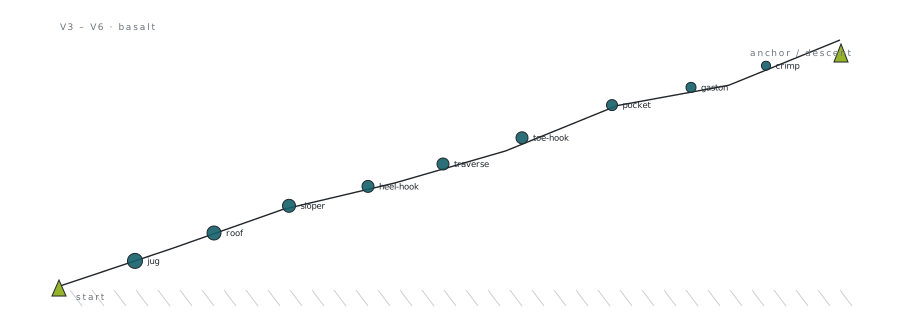
Hold types jug · roof · heel-hook
Open beta
Steep roof on huge holds. The standard first hard-looking problem in Bishop and much easier than it appears from the ground.
-
Hold types traverse · sloper · heel-hook
Open beta
Long rising traverse across the main wall. Pump is the only difficulty; find the knee bar at the halfway point.
-
Hold types pocket · roof · gaston
Open beta
Short, intense roof on pockets with a long gaston exit. Very condition-dependent for volcanic tuff — cold mornings are dramatically better.
-
Hold types crimp · roof · toe-hook
Open beta
Long roof with a hard exit. Set the toe hook early in the horizontal and do not let go of it until both hands are over the lip.
Crag ethics
Crag ethics
Do not build new trails or cairns, do not remove vegetation for landings, and do not wire-brush volcanic tuff. Chalk is brushed off at the end of the session.