Camp 4 Boulders
V4 – V7 · 4 routes · granite · V-scale
- Approach 3 min — flat valley floor, walk west out of the Camp 4 car park
- Best season April to mid-June and September to November. The valley floor holds snow in mid-winter.
- Published
- Updated
The Camp 4 boulders sit a two-minute walk from the historic climbers' campground and carry more climbing history per square metre than almost anywhere on earth. The rock is coarse granite, the landings are sandy and level, and the problems reward technique over raw strength.
The climbing
Expect steep faces on small edges, mantles onto polished slabs and a handful of problems where the crux is a single hard move out of a horizontal break. The coarse texture makes tiny holds usable, but it also eats skin fast — plan for two or three hours rather than a full day.
The grades run from V0 to V12, but the concentration is V4 to V8. That middle range is where the area's reputation was made.
Season and conditions
The valley floor sits at 1,200 m and holds snow from December into March. The bouldering season is April to early June and September to November. Late spring is best for the harder problems — the rock is dry and the friction is high before the summer heat arrives.
Afternoon thunderstorms are normal in July and August. Rock that was dry at noon can be wet by three.
Logistics
Camp 4 itself is a walk-in campground with a queue system, and it is usually full. Valley lodging books months ahead. Walk from the campground or the village store; parking near the boulders is limited and enforced.
Routes · 4
-
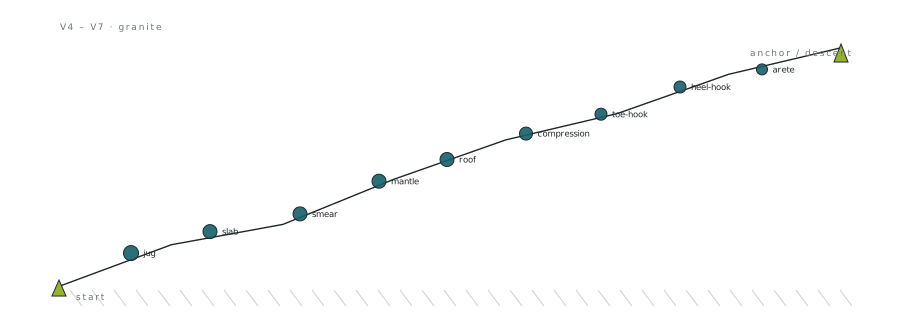
Hold types slab · smear · mantle
Open beta
Polished friction slab above a sandy landing. Weight on the toes, hips in, and do not look down at the last move.
-
Hold types jug · overhang · toe-hook
Open beta
Steep jug haul that is the standard warm-up for the harder lines. A toe hook on the left keeps the swing under control.
-
Hold types crimp · roof · heel-hook
Open beta
Steep crack line with a hard first move off a right-hand edge. Heel hook deep in the break, then reach through rather than up.
-
Hold types arete · sidepull · compression
Open beta
Long arete climbed on its right side. The crux is the third move, where the only foothold is a smear on a polished patch.
Crag ethics
Crag ethics
Yosemite granite is heavily used. Do not wire-brush, do not chip, and do not add chalk to the tops of the classic slabs. Leave no trace at the campground.